Posts

Showing posts from February, 2011

Yes, Monetary Policy Does Matter
Image
Christina Romer has an Op-Ed on U.S. monetary policy that raises several important points.  First, she does a good job explaining that monetary policy can still pack a punch even when short-term interest rates are close to zero.  She reminds us that unconventional monetary policy during the Great Depression--the original QE program--did wonders for the economy in a far worse economic environment than today. If it did such an incredible job back then, why couldn't it do the same today?   This is a point I made late last year to Paul Krugman.  It should encourage folks like him and Mark Thoma to be more optimistic about what monetary policy can do to shore up the  recovery.   Second, Romer explains why U.S. monetary policy is not doing more given its untapped potential.  She attributes this failure to to a polarizing division among  two types of policymakers: empiricist and theorist.  Here is how she describes them: Empiricists, ...

More Questions for Bernanke When He Testifies

Caroline Baum has five questions for Fed Chairman Ben Bernanke when testifies to Congress on March 1-2.  She has great questions for Bernanke and I hope someone in Congress will ask them. Here is one more question I would like to see Congress ask Bernanke: "Chairman Bernanke, the minutes of the September, 2010 FOMC meeting show that nominal GDP targeting was discussed.  Other observers have also been discussing the idea.  What are your thoughts on nominal GDP targeting as a way to conduct U.S. monetary policy?" If case anyone is interested, here are some posts that make the case for a nominal GDP level target: (1) The Case for Nominal GDP Targeting . (2) Thoughts on the Tyler Cowen-Scott Sumner Debate.   (2) Why a Nominal GDP Level Target Trumps a Price Level Target. (3) Target the Cause Not the Symptom.

Inflation Targeting Gets a Black Eye, But It Had It Coming

Inflation targeting has been taking a beating across the Atlantic.  In the United Kingdom, where there is an explicit inflation target, it appears the Bank of England is getting ready to tighten monetary policy despite ongoing economic weakness.   The reason for the expected tightening is rising inflation, even though the recent  increases may be a one-off event.  Nonetheless, because of its inflation target the Bank of England seems set to reign in  aggregate demand regardless of  the consequences for the economy. This makes little sense.  Nick Rowe notes that this experience raises tough questions for those who believe  that monetary policy that stabilizes inflation will also tend to stabilize economic activity.  Scott Sumner goes  says this experience shows the failure of  inflation targeting.  I say it definitely gives inflation targeting a black eye, but it had it coming.   Inflation targeting is an im...

Four Questions for Ben Bernanke on His Global Saving Glut Hypothesis

Image
Ben Bernanke delivered a speech Friday where he further developed his global saving glut (GSG) hypothesis.  This view holds that the reason for the low long-term interest rates in the United States during the early-to-mid 2000s was that desired saving vastly exceeded desired investment in emerging economies.  Consequently, capital flowed from these countries to the U.S. economy and pushed down long-term interest rates.  The cheaper credit in turn fueled the U.S. housing boom.   Based on  a new research paper , Bernanke extends his GSG hypothesis by considering the type of assets desired by these emerging economies as they invested in the U.S. economy.  He shows that investors from these countries, as well as  from Europe, had a strong appetite for AAA-rated assets which were in short supply elsewhere.  Given the limited supply of Treasury and agency securities, the U.S. financial system responded by transforming risky assets into safe assets...

Is the U.S. Treasury Department Undermining QE2?

Image
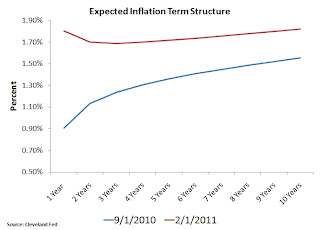
According to Jim Hamilton, the answers is  yes.  He shows that the average maturity of publicly-held U.S. debt continues to grow despite the Fed's QE2 program.  This should not be the case.  Under QE2, the Fed is purposefully trying to lower the average maturity of Treasury securities for reasons that will be explained later.  The fact that the Fed is not shortening the average maturity means that the Treasury is issuing long-term debt faster than the Fed is buying it up.  Nonetheless, there is still evidence that that QE2 is having an effect on nominal and real expectations as seen here .  Thus, the U.S. Treasury Department has not completely thwarted the Fed's efforts, but it is surprising to see fiscal policy and monetary policy working against each other here. So why does the average maturity of Treasury securities matter?  The standard answer is that if the Fed reduces the average maturity then there will be a drop in the net supply of long...

The Great Stagnation and Total Factor Productivity

Image
Tyler Cowen responds to some of the Great Stagnation critics by pointing to trends in total factor productivity (TFP): The critical responses to The Great Stagnation prefer to attack median income measures and in general they are reluctant to talk about total factor productivity.  Yet we are pointed very much toward the same conclusion. The point is that the Great Stagnation theory matches nicely with the standard story of TFP growth:  there was a "golden age" of TFP growth during the1948-1973 period, but thereafter it stalled  until about 1995.  That is an interesting rebuttal from Cowen, but haven't we made some impressive TFP gains since 1995 given the advances in technology?  To see just how marked this TFP decline was after 1973 and whether the recent TFP gains make up for any of the loss, I went to the data.  Below is a figure constructed using the quarterly TFP series of John Fernald at the San Francisco Fed. (Click on figure to enlarge.) ...

CTU's Jack Bauer on the Great Stagnation Hypothesis

I have been reading with interest the discussion surrounding Tyler Cowen's new book, The Great Stagnation .  The main argument of the book is that the technological progress has slowed. We have picked the "low-hanging fruit" of economic growth and now are mired in slow growth.  Count me a skeptic on this one.  I believe we have just gone through one of the greatest technological innovations of our time with the advent of the internet and faster computing.  Moreover, these technologies are still improving and the potential positive spillover effects from the rest of the world catching up with the advanced economies are tremendous (e.g. imagine what will happen to R&D funding on cancer and AIDS once several billion Asians are rich enough to start demanding it).  Rather than a great Stagnation, I see us at that cusp of a Great Acceleration. Regarding the past few decades, Cowen cites the decline in median income to support his thesis.  I can only cite ane...

Bernanke and Commodity Prices

Image
Bernanke responds today to the accusation that the commodity price boom is being caused by U.S. monetary policy: Supply and demand abroad for commodities, not U.S. monetary policy, are causing higher food and energy prices rattling much of the world, Federal Reserve Chairman Ben Bernanke said Thursday.  “The most important development globally is that the world is growing more quickly, particularly in emerging markets,” Bernanke said in response to a question after his speech at the National Press Club ...“I think it’s entirely unfair to attribute excess demand in emerging markets to U.S. monetary policy,” Bernanke said. Those nations can use their own monetary policy and adjust exchange rates to deal with their inflation problems, he said. “It’s really up to emerging markets to find appropriate tools to balance their own growth.” Scott Sumner and Paul Krugman would agree with this assessment.  Here is an update figure from an earlier post that shows the year-on-y...

Bernanke Acknowledges Risings Yields a Sign of Success

Image
For some time now, I have been making the case that a sign of QE2 success would be rising yields rather than falling yields.  Yes, interest rates may initially fall, but if QE2 is successful in raising expectations of real growth then interest rates should start to increase.  For example, back in December, 2010 I said the following: If QE2 is successful, then we would expect treasury yields to rise!  A successful QE will first raise inflation expectations.  This alone will put upward pressure on nominal yields.  However, expectations of higher inflation are in effect expectations of higher nominal spending.  And higher expected nominal spending in an economy with sticky prices and excess capacity will lead to increases in expected real economic growth.  The expected real economic growth should in turn increase real yields.  It is that simple. Here is an updated graph from a more recent post that indicates this is in fact happening: Giv...