Posts

New Articles on NGDP Targeting

Just a quick note on a couple of my papers that recently got published. First,  Josh Hendrickson and I published in the Journal of Money, Credit, and Banking  earlier this year with an article titled " Nominal GDP Targeting and the Taylor Rule on an Even Playing Field ". Here is the abstract: Some economists advocate nominal GDP targeting as an alternative to the Taylor Rule. These arguments are largely based on the idea that nominal GDP targeting would require less knowledge on the part of policymakers than a traditional Taylor Rule. In particular, a nominal GDP targeting rule would not require real‐time knowledge of the output gap. We examine the importance of this claim by amending a standard New Keynesian model to assume that the central bank has imperfect information about the output gap and therefore must forecast the output gap based on previous information. Forecast errors by the central bank can then potentially induce unanticipated changes in the short‐term nomin...

Is the Fed's Floor System Beginning to Fold?

Image
Last December, I participated in an AEI event where I made the case that the Fed's current floor operating system could collapse into a corridor operating system fairly soon. My argument was that even without a significant reduction in the supply of reserves, a large shift in the demand for reserves could be sufficient to move the Fed off the perfectly elastic or 'flat' portion of the bank reserve demand curve. The Fed, in other words, could have a relatively large balance sheet and still end up in a corridor operating system.  Graphically, such a development is depicted in the figures below. The figure on the left shows a floor operating system with a large supply of reserves on the flat portion of demand curve. In this system, the IOER is both the target and overnight interest rate. The second figure on the right shows what I imagined could be happening. The demand for reserves was shifting outward because of new regulatory requirements and the supply of reserves wa...

Is Low Inflation Really a Mystery?

Image
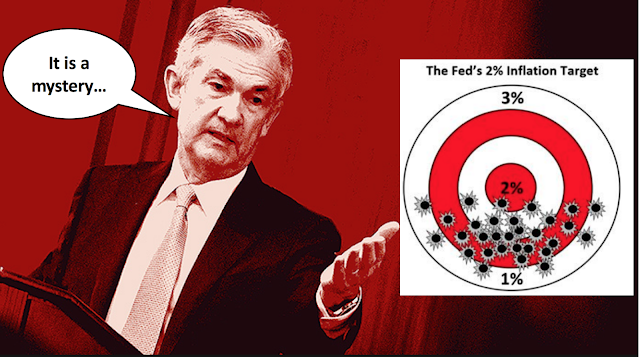
Over the past decade, inflation has persistently undershot the Fed's inflation target. The Fed's preferred measure of inflation, the core PCE deflator, has average 1.56 percent over this time compared to a target of 2 percent. The Fed officially begin inflation targeting in 2012, but was implicitly targeting 2 percent long before that time. So below-target inflation has been happening for close to a decade and for many observers it is a mystery. There have been a spate of articles as to why the Fed has not been able to hit its inflation target. Some have wondered if the Fed really understands or even controls the inflation rate . Even Fed officials have been perplexed by the low inflation since it cannot be explained by their Phillips curve models. As a result, they sometimes attribute the persistently low inflation to developments such as falling oil prices, demographics, global competition, changes in labor’s share of income, safe asset shortage, and even the ...

The FOMC Decision: A NGDP Perspective

Image
The FOMC voted this week not to raise its target interest rate and signaled no additional hikes are planned for this year conditional on the outlook. This is a big change from last fall when the FOMC was talking up multiple rate hikes and dismissing concerns about the flattening yield curve. This 11th-hour conversion to a more dovish stance is a remarkable turnaround, one that some observers like Tim Duy are calling a "major break ".  The change is being attributed to growth concerns and a weakening of financial markets. I do not want to go through all the indicators supporting the Fed's worries, but I do want to see whether Nominal GDP (NGDP) lends support to this decision. As many readers of this blog know, I believe that properly evaluated NGDP growth is probably the best indicator of the stance of monetary policy. Okay, so what does it say? To answer that question, I like to look at a measure called the 'sticky forecast' growth path for NGDP and co...

Oh, the Horror of a Corridor!

Image
The December 2018 FOMC minutes are out and reveal members continue to discuss the potential long-run frameworks for monetary policy implementation. Their discussion as to whether they should keep their current floor operating system or move to a corridor operating system can be illustrated using the figure below: The FOMC likes the floor system since it separates the size of the Fed's balance sheet from the setting of its target interest rate. This added flexibility is possible because the reserve supply schedule is on the horizontal part of the reserve demand curve as seen above. Here, banks will take all the reserves sent their way--killing off interbank lending--as their demand for reserves is perfectly elastic. The corridor system puts the reserve schedule back on the downward slopping part of the reserve demand curve. That creates an opportunity costs for reserves and resurrects interbank lending.  Recall that the floor system is a byproduct of the crisis. It wa...

A Risk Sharing View of Monetary Policy

Image
I have a new working paper titled " Better Risk Sharing Through Monetary Policy? The Financial Stability Case for a Nominal GDP Target " . I presented this paper at the recent Cato Monetary Policy Conference.  Here is the abstract: A series of papers have shown that a monetary regime targeting nominal GDP (NGDP) can reproduce the distribution of risk that would exist if there were widespread use of state contingentdebt securities (Koenig, 2013; Sheedy, 2014; Azariadis et al., 2016, Bullard and DiCecia, 2018). This paper empirically evaluates this view by exploiting an implication of the theory: those countries whose NGDP stayed closest to its expected pre-crisis growth path during the crisis should have experienced the least financial instability. This paper constructs an NGDP gap measure for 21 advanced economies that is used to test this implication. The results strongly suggest that there is a meaningful role for NGDP in promoting financial and economic stability. A...

How Close is the Fed to a Corridor System?

Image
I recently participated in an AEI event that showcased George Selgin's new book on the Fed's floor  system. My role at the event was to comment, along with  Bill Nelson , on George's book.  Readers of this blog will know I share many of George's concerns about the floor system that are outlined in his book and I would like to see the Fed move to a symmetric corridor system. The FOMC spent a good portion of its November meeting discussing this issue . My comments at the AEI event, however, were not on the tradeoffs between a corridor and floor system but rather on how close the Fed currently is to a corridor system. There are some indicators that the Fed may not be too far away. To illustrate my point, consider the figures below. The question I considered is how far the Fed is from transitioning from the figure on the left below to the one on the right. Note, that there are two ways to make this move. First, the supply of reserves (red line) can shift back ...